

PROJECT:
Financial Disclosure Research
B2B SaaS · Financial & Regulatory Business Intelligence · End-to-end Design & Delivery
Context
After acquiring the Disclosure Research product, the company commissioned an external agency to redesign the platform. The agency delivered a clean prototype, but it was designed without real data. When the development team implemented it, the interface broke: document titles ran to 200+ characters and overflowed the layout, filter panels were too narrow to display their content, and navigation didn't account for actual user workflows. By the time I joined, significant engineering effort had already gone into this implementation, and leadership wouldn't approve fundamental structural changes such as reworking the layout or information hierarchy. No one was auditing design decisions against real usage, resolving layout problems as they arose, or giving developers consistent specifications to work from.
My role
Stepped in as the first and only designer on this product. I had been studying design independently for over a year alongside managing the data quality team of the same organisation, and when the development team saw the implementation failing without design guidance, they backed my proposal to take it on. Audited the interface against real data and legacy test cases, then created prototypes addressing core workflows and UI component consistency within the constraints of what had already been built. Established the design system of reusable components, set up design operations with a design sprint cadence as part of the SDLC that kept implementation uninterrupted, and owned the full design surface for over two years, both before and after my promotion to Product Manager.
Impact
Successfully migrated the customer base from legacy to the redesigned platform, retaining 95% of customers while improving the user experience.
Built a design system from scratch that established consistent patterns and halved development delivery time.
Received a company-wide leadership award for contributions to product design and engineering impact.
Stepped in to correct UX/UI issues. Stepped up to work on Disclosure Research. All while leading her own DQA Team.
— Leadership award citation
Solution overview
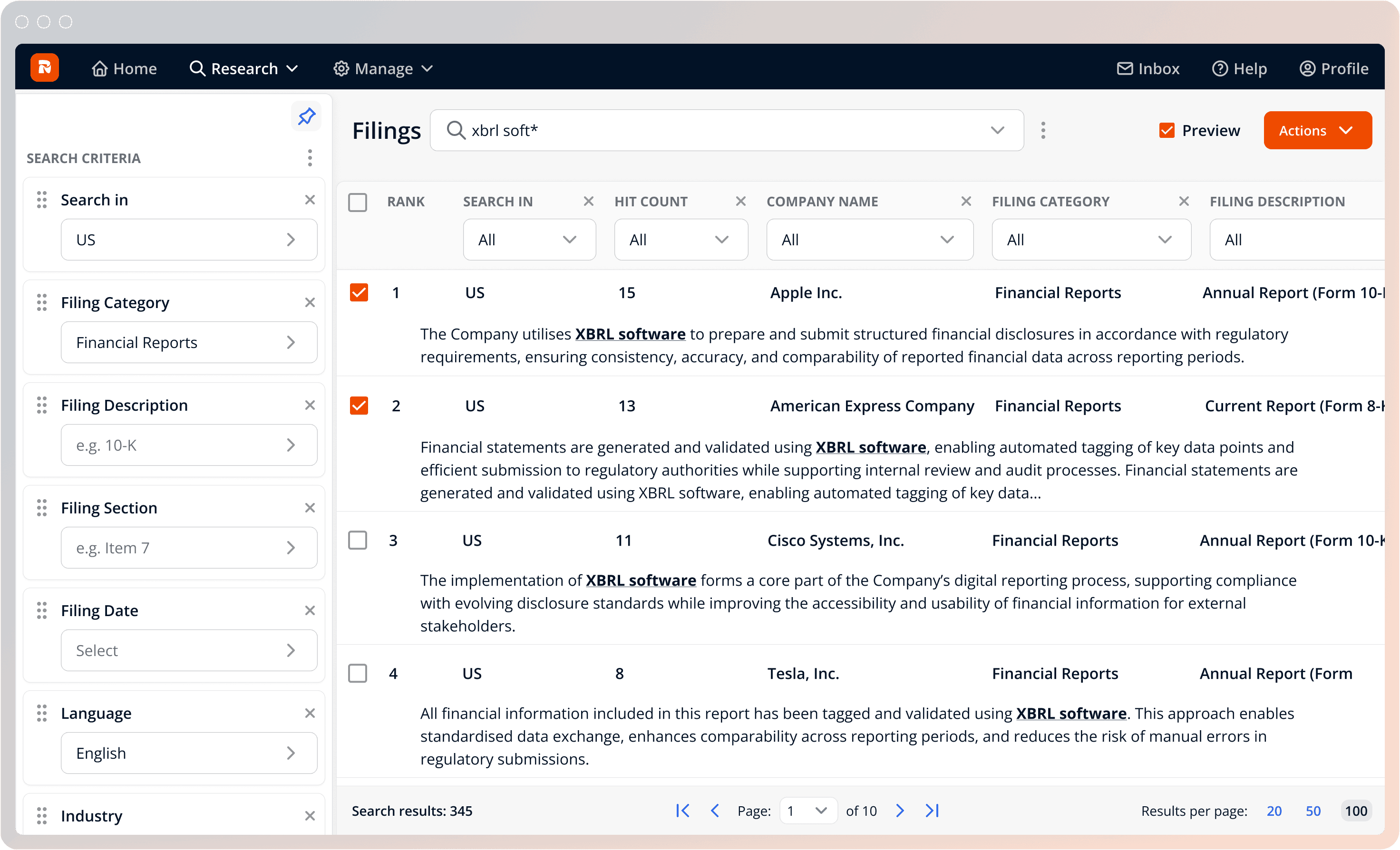
A financial intelligence and research platform used by Fortune 500 companies to analyse public disclosure filings, benchmark corporate peers, and inform critical investment and compliance decisions. Every design decision had to account for dense, variable-length data, complex filtering across multiple dimensions, and workflows where speed of access directly affected users' ability to do their jobs.
Research across data sets
The product offers research across various data sets with consistent interaction patterns: full text search (if applicable), search criteria and actions that can be applied to search results.

Search automation
In addition to advanced search, users can automate repetitive tasks by saving popular searches, getting alerts for new results, and sharing search settings with their team members.

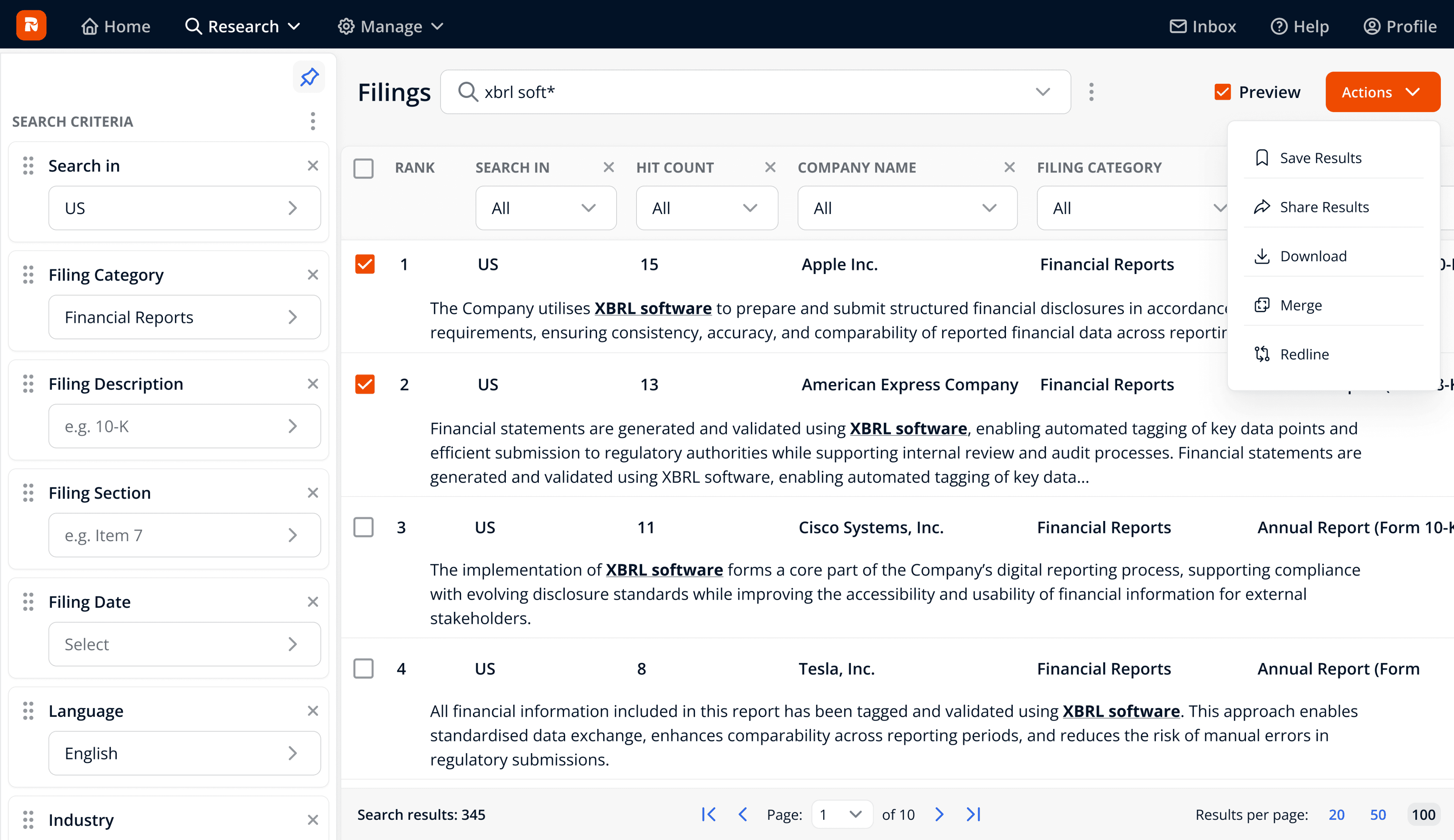
Search results management
Once search results are received, users can save them to dedicated projects, share with others, download, merge or redline right in the application to speed up their tasks.
Detailed view
Every search result can be opened in a detailed view to quickly navigate search keywords in large volumes of text, quickly locating important information.

Quick access to relevant searches
One of the core experiences that were misunderstood by the external design agency, initially hiding it within application settings. We brought access to the saved searches where it was naturally expected, significantly improving solution usability.


Reflection
This project marked my transition into product design. As the sole designer on a complex enterprise product, I relied heavily on cross-functional collaboration: QA test cases from the legacy application surfaced missing functionality and edge cases that research alone would have missed, engineers grounded decisions in technical constraints, and CS and Sales brought deep knowledge of user workflows and relevant requirements. What worked for me in this project and what I bring with me forward: when there's resistance to design changes, build a prototype to prove your point. It's faster to show value visually and interactively than to try aligning different stakeholders' mental models through arguments, research findings, or industry standards alone.